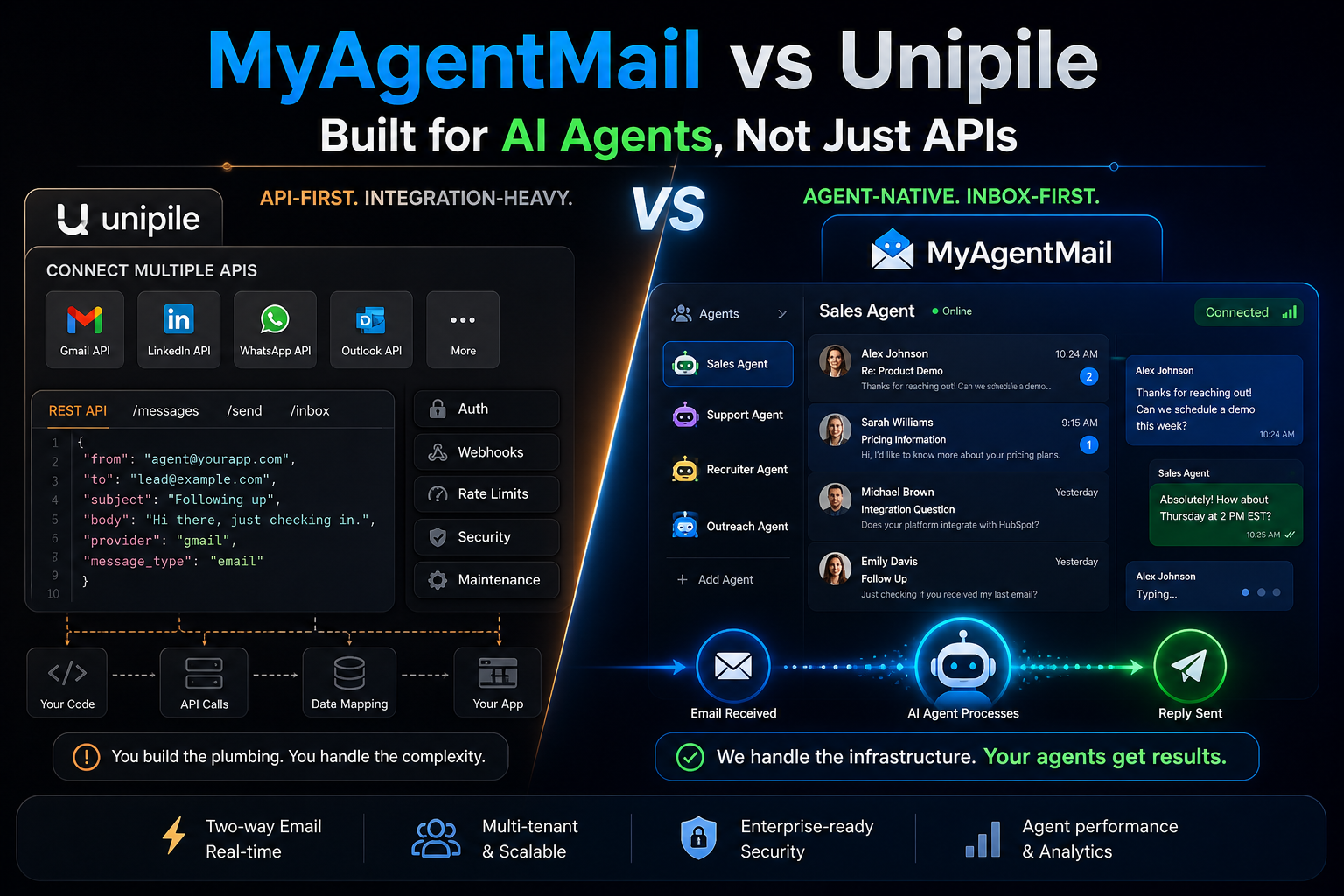
MyAgentMail vs Cloudflare Email for Agents — Comparison

MyAgentMail vs Cloudflare Email for Agents
Cloudflare announced Email for Agents in April 2026 — a bidirectional email service built into Workers. It's a strong signal that email infrastructure for AI agents is becoming a real category.
Here's an honest comparison of the two platforms so you can pick the right one for your use case.
Quick summary
| MyAgentMail | Cloudflare Email | |
|---|---|---|
| Approach | Standalone email API — works with any stack | Part of the Cloudflare Workers platform |
| Protocols | REST + IMAP + SMTP | REST + Workers binding |
| Custom domains | Any DNS provider, any TLD | Must be on Cloudflare DNS |
| Multi-tenancy | Built-in workspaces with scoped API keys | Not available — one account per project |
| Pricing | From $5/mo (2 inboxes, 6,000 emails) | $5/mo Workers plan + 3,000 free then $0.35 per 1,000 |
| Lock-in | None — platform agnostic | Requires Cloudflare Workers |
Feature comparison
Sending and receiving email
Both platforms let agents send and receive email via API. The key difference is how.
MyAgentMail exposes a REST API that works from any language, any hosting provider, any framework. You also get full IMAP and SMTP access — your agents can connect using standard email clients or any IMAP library.
Cloudflare provides a Workers binding (JavaScript only, runs on Workers) and a REST API. There is no IMAP or SMTP access. If you need to connect to an inbox from outside Workers, your only option is the REST API.
Inbox provisioning
MyAgentMail lets you create inboxes on the fly via API. Each inbox is a real mailbox with its own address, storage, and credentials. You can spin up hundreds programmatically.
Cloudflare doesn't have an inbox concept. Incoming email is routed to Workers handlers based on address patterns. There's no persistent inbox — your Worker code decides what to do with each message.
Custom domains
MyAgentMail works with any DNS provider. Add your domain, configure the DNS records we give you, and you're sending. Any TLD is supported.
Cloudflare requires your domain to be on Cloudflare DNS. If your domain is on Route 53, GoDaddy, or another provider, you'll need to transfer or proxy through Cloudflare first. SPF, DKIM, and DMARC are configured automatically once the domain is on their platform.
Multi-tenancy
MyAgentMail was designed for multi-tenant SaaS from day one. Workspaces isolate tenants with their own API keys, inboxes, and custom domains. You can build a platform on top of MyAgentMail where each of your customers gets their own isolated email environment.
Cloudflare has no multi-tenancy model. Each Cloudflare account is a single tenant. If you're building a SaaS that gives customers their own agent email, you'd need to manage isolation yourself.
Threading and drafts
Both platforms support email threading.
MyAgentMail also has a full drafts API — create, update, and send drafts. This enables human-in-the-loop workflows where an agent drafts a reply and a human reviews before sending.
Cloudflare does not mention draft support. Their model is more fire-and-forget: the agent processes inbound email and sends a reply.
Real-time events
MyAgentMail offers WebSocket connections for real-time inbox events and webhooks for async notifications.
Cloudflare uses Workers event handlers (onEmail hook). This is event-driven but only available inside the Workers runtime — you can't subscribe to events from an external service.
Bounce and deliverability monitoring
MyAgentMail has built-in bounce rate monitoring, automatic agent pausing above thresholds, disposable domain filtering, and account-level suppression lists. If an agent's bounce rate exceeds 2% or complaint rate exceeds 0.1%, sending is automatically paused to protect your domain reputation.
Cloudflare handles bounces at the infrastructure level — hard bounces are never retried and addresses are added to a suppression list, while soft bounces are retried with exponential backoff. They also provide analytics and observability dashboards. However, there's no automated agent-level pausing or pre-send validation like disposable domain filtering.
MCP server
Both platforms provide an MCP server so AI agents (Claude, Cursor, etc.) can discover and use email tools.
SDKs
MyAgentMail has a TypeScript SDK.
Cloudflare has TypeScript, Python, and Go SDKs, plus a Wrangler CLI integration.
Pricing
MyAgentMail has transparent, predictable pricing:
| Plan | Price | Inboxes | Emails/mo |
|---|---|---|---|
| Starter | $5/mo | 2 | 6,000 |
| Developer | $15/mo | 10 | 20,000 |
| Startup | $199/mo | 200 | 150,000 |
Cloudflare requires the Workers Paid plan ($5/mo). You get 3,000 outbound emails/mo included, then $0.35 per 1,000 emails after that. Email Routing (inbound) is free on all plans.
At 20,000 emails/mo: $5 + (17,000 / 1,000 × $0.35) = $10.95/mo — but with no inboxes, no multi-tenancy, and no IMAP/SMTP.
At 150,000 emails/mo: $5 + (147,000 / 1,000 × $0.35) = $56.45/mo for sending alone. MyAgentMail's Startup plan at $199/mo includes 200 inboxes, 200 custom domains, and the full feature set.
Other Cloudflare limits: variable daily sending caps per account (adjusted based on behavior), 50 recipients per email, 25MB message size. MyAgentMail has fixed, predictable limits on all plans.
When to use Cloudflare
Cloudflare Email for Agents makes sense if:
- You're already building on Cloudflare Workers
- You only need API-based send/receive (no IMAP or SMTP)
- You don't need multi-tenancy
- You want tight integration with Durable Objects for state persistence
When to use MyAgentMail
MyAgentMail is the better fit if:
- You want a platform-agnostic email API with no infrastructure lock-in
- You need IMAP and SMTP access (connecting agents via standard email clients)
- You're building a multi-tenant SaaS where each customer needs isolated email
- You want built-in deliverability monitoring and bounce handling
- You need draft management for human-in-the-loop workflows
- Your DNS is not on Cloudflare and you don't want to move it
Both are solid products solving a real problem. Cloudflare brings their massive brand and infrastructure. MyAgentMail brings flexibility, protocol support, and multi-tenancy. Pick the one that fits your stack.
Get started with MyAgentMail — 7-day free trial on all plans.